Test Harry Potter
Weasley: which of these seven family members are you like?
A flooded workshop and a little cloud held in brass rings: ten scenes to make room for memories, inventions and a wish of your own.
PICTURE THE SCENE
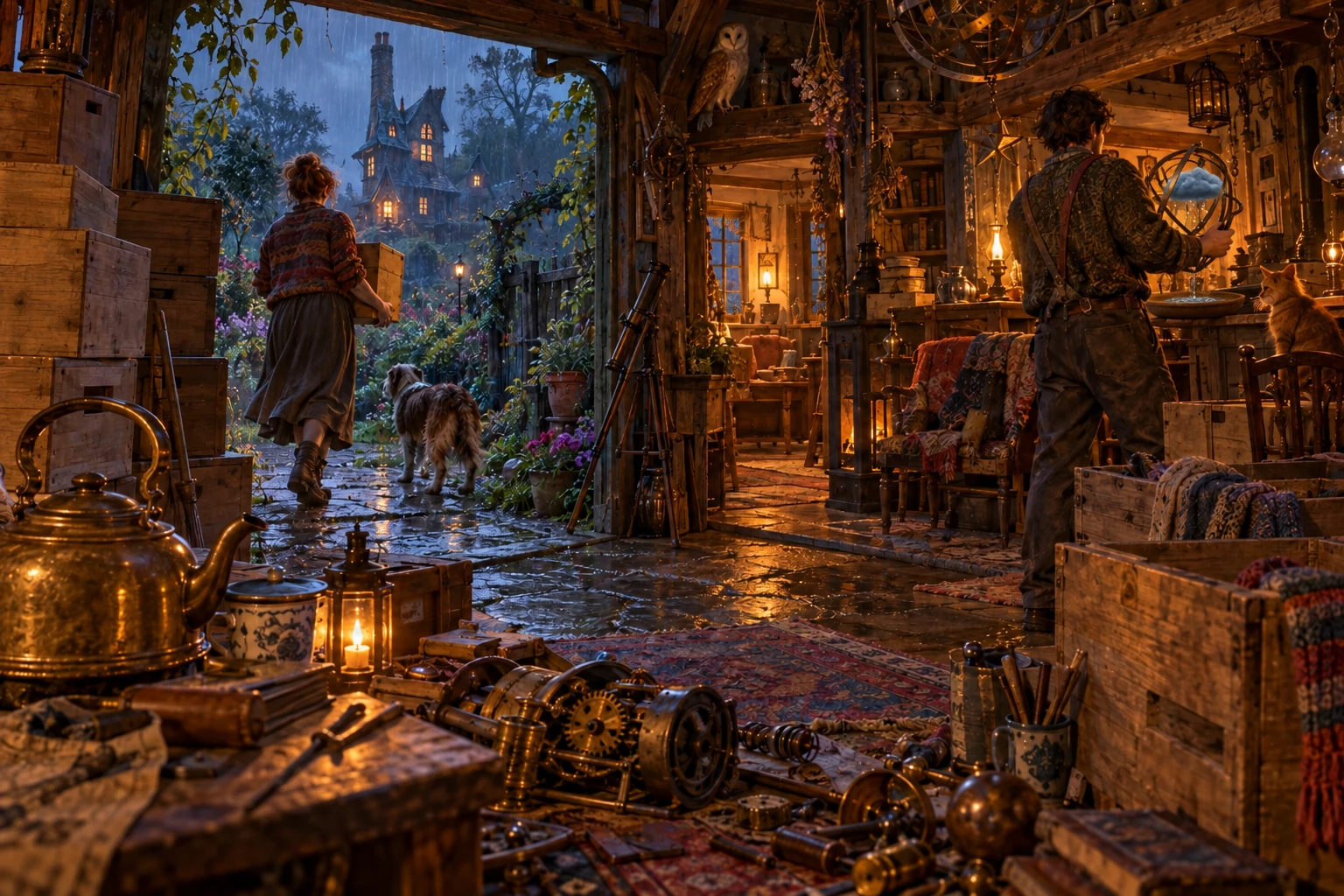
Water is leaking through the Bellams’ workshop roof. The invented family, neighbours of the Burrow, asks for your help: everything must move into a smaller room by evening. Among Lia’s father’s projects is a rain-catcher: brass rings hold drops in a little cloud, then release them into a basin. Moving that small storm without spilling it will take more than filling boxes. Lia wants to preserve the projects; Tobin wants a bench for inventing. Magic will not make the new room bigger for you.
Tap to make each choice. Your result is free.
Original fan fiction in the world of the first five Harry Potter films, through Order of the Phoenix (2007). The affinity concerns a selection of seven Weasleys, not the whole family or an assigned family relationship. The Bellams, move, rain-catcher and other prototypes are invented, not canonical products. Retained portraits draw on Molly in 2011, Arthur in 2002 and the twins in 2004; no event after 2007 enters the story or endings. The other domestic poses are new fan scenes. Choices do not measure personality or magical ability; the twins’ differences are interpretations, not opposite canonical temperaments.
The world behind the story
Molly Weasley — official fact file ↗Arthur Weasley — official fact file ↗Fred Weasley — official fact file ↗George Weasley — official fact file ↗Ron Weasley — official fact file ↗Ginny Weasley — official fact file ↗Percy Weasley — official fact file ↗The Weasleys — family and connections ↗The Burrow — place and residents ↗How this quiz works
10 choices or questions, taking about 9 minutes to read and answer. Reading your result takes additional time, at your own pace.
Your choices shape an original journey and lead to a narrative portrait. There are no right answers: you can go back and change your mind.
Your answers stay in the page’s memory. Read how the results are created.