Test Dragon Ball
Which Dragon Ball Technique Reflects You?
You return to Kame House with a drawing of an old performance you made together. Mira wants a different ending. Which of six Dragon Ball techniques reflects the mark you want to leave?
PICTURE THE SCENE
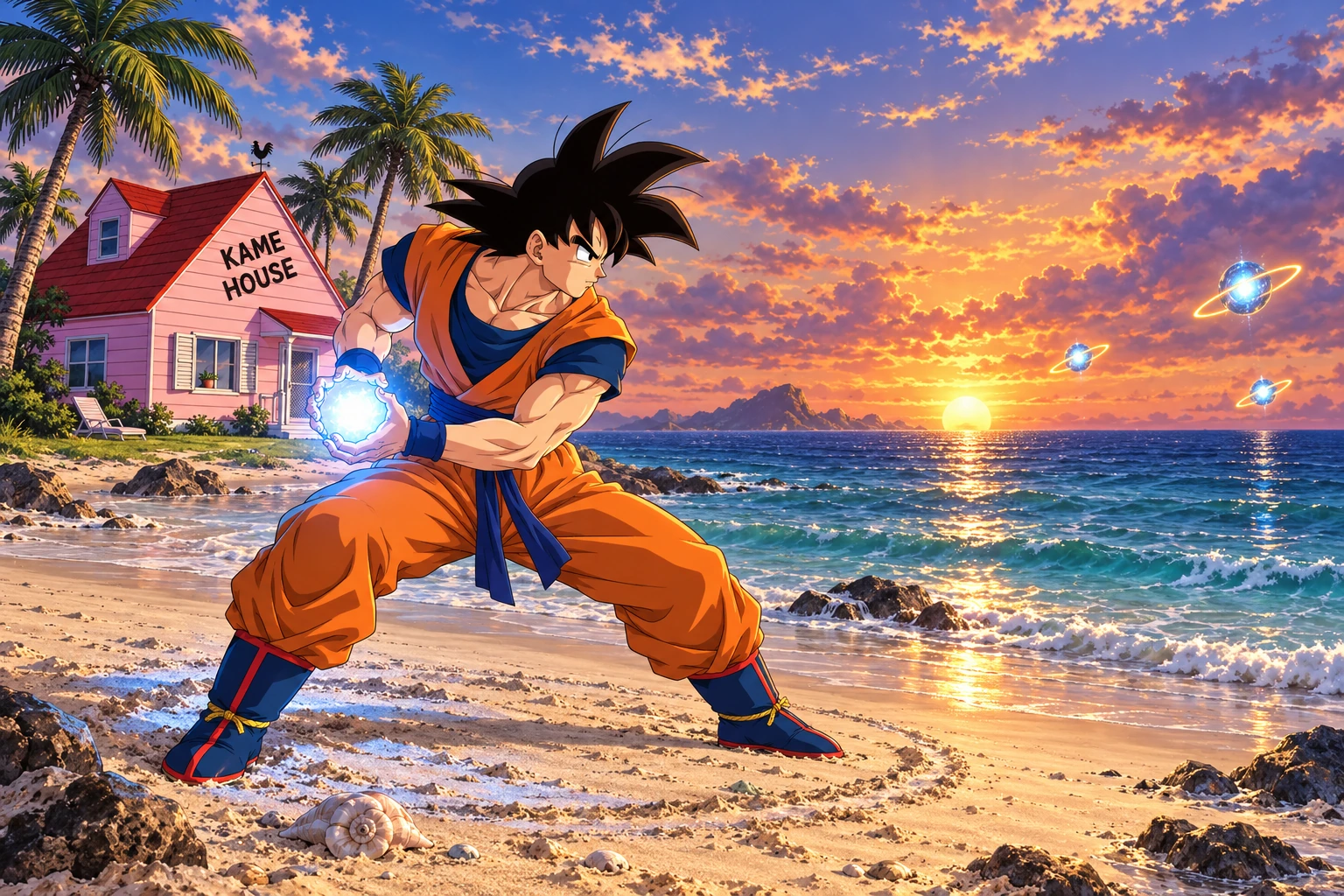
Your bag still holds the drawing of Double Tide: a blue spiral inside an amber circle, with your name and Mira’s underneath. You invented it during your first ki practices at Kame House. Then you left the island for a year. Your messages grew less frequent; Mira hugs you when you return, but you don’t yet know whether you have kept the same things from that time. You are both adults now and can produce small pulses of light. Bulma has suspended three targets above the sea. Their blue centres and amber rings hold the light of your pulses for a few moments, long enough to trace a shape. At sunset you will perform a short sequence for visitors arriving by ferry, between demonstrations by Goku, Krillin and Piccolo. Master Roshi asks for a title to put on the programme. You say ‘Double Tide’ before asking Mira. She sees the paper poking out of your bag. ‘You’ve still got it,’ she says. Then she draws two circles in the sand, a little farther apart than you remember.
Tap to make each choice. Your result is free.
An original fan adventure outside any specific episode. Mira, your shared past, Double Tide, the ferry and the glowing targets are invented. The six results are techniques, rather than the characters illustrating them. Your small pulses belong to the fiction; the affinity concerns the story’s desires and tensions, without teaching ki use or measuring real abilities.
The world behind the story
Dragon Ball Official — manga techniques and Sparking! ZERO ↗Dragon Ball Official — North Kai, Kaio-ken and the Spirit Bomb ↗Dragon Ball Official — Instant Transmission locates an individual’s ki ↗Dragon Ball Official — Kaio-ken amplifies ki ↗Dragon Ball Official — Kame House and its island ↗How this quiz works
8 choices or questions, taking about 7 minutes to read and answer. Reading your result takes additional time, at your own pace.
Your choices shape an original journey and lead to a narrative portrait. There are no right answers: you can go back and change your mind.
Your answers stay in the page’s memory. Read how the results are created.